India’s 2026 Union Budget sparks mixed market reactions, boosting growth yet signaling investor caution and opportunities.
India’s Union Budget 2026 has sent ripples across equity, bond, and sectoral markets. While certain measures aim to boost growth, others signal caution for investors. Here’s a closer look at the key takeaways and their market implications.
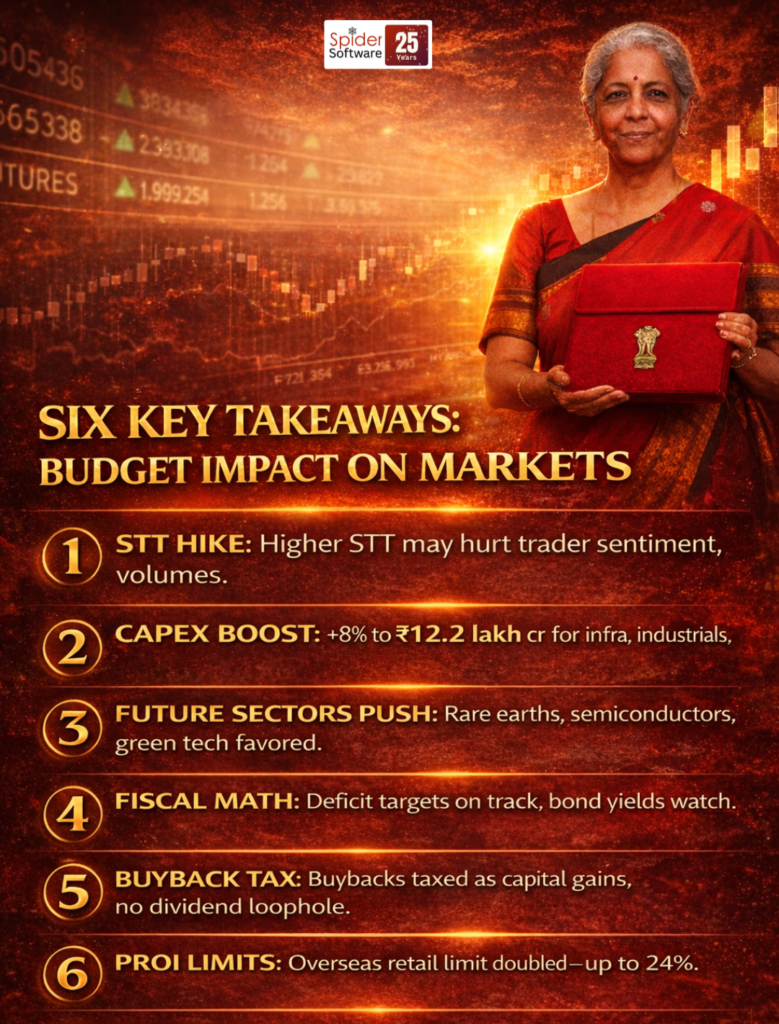
1. STT Hike on F&O Dampens Trading Sentiment
The government has raised the Securities Transaction Tax (STT) on Futures & Options (F&O) to 0.5%, a move that has investors concerned about trading costs. With derivatives volumes already declining, this hike could further weigh on liquidity and market sentiment in the near term. Traders and active participants may need to recalibrate strategies to account for higher transaction costs.
2. Capex Boost Supports Infrastructure and Industrials
Capital expenditure has been increased by 8% to ₹12.2 lakh crore, signaling strong government intent to accelerate infrastructure development. Sectors like construction, industrials, and engineering are likely to benefit directly, and companies in the order pipeline could see greater visibility. This push reinforces India’s long-term growth narrative, especially for manufacturing and heavy industries.
3. Policy Focus on Future-Growth Sectors
The budget includes targeted support for semiconductors, rare earths, biosimilars, and clean technologies. This sectoral emphasis positions India as a global hub for high-growth industries. Early reactions in the stock market already indicate gains in companies aligned with these initiatives, suggesting that policy support can translate into tangible equity performance.
4. Fiscal Deficit Targets and Borrowing Concerns
Fiscal discipline remains a priority, with deficit targets set at 4.4% for FY26 and 4.3% for FY27. However, slightly higher borrowing requirements could keep bond yields volatile. Fixed income investors may need to watch government borrowing closely, as it could influence interest rates and liquidity in debt markets.
5. Buybacks Now Taxed: End of Dividend Arbitrage
A significant shift in tax policy means corporate buybacks will now attract capital gains tax—22% for promoters and up to 30% for non-corporate shareholders. This effectively ends the tax arbitrage that previously favored buybacks over dividends. Companies and investors will need to rethink capital return strategies, potentially affecting corporate behavior and shareholder returns.
6. PROI Equity Ownership Limits Raised
The government has doubled individual overseas ownership limits in Indian equities to 10% from 5%, and expanded aggregate overseas retail ownership to 24% from 10%. While this is unlikely to trigger immediate capital inflows, it improves India’s attractiveness to global investors and could enhance market depth over time.
Conclusion
The Budget 2026 strikes a balance between growth promotion and fiscal prudence. While policy initiatives for infrastructure, semiconductors, and clean tech offer long-term upside, short-term challenges such as the STT hike and new buyback taxes could temper market enthusiasm. Investors should weigh sectoral opportunities against near-term headwinds to navigate the evolving landscape effectively.
Voice Of Traders by Spider Software
HDFC Securities’ SECRET Stock Picking Formula! (STRATEGY REVEALED)

Disclaimer: The information provided in this Blog is for educational purposes only and should not be construed as financial advice. Trading in the stock market involves a significant level of risk and can result in both profits and losses. Spider Software & Team does not guarantee any specific outcome or profit from the use of the information provided in this Blog. It is the sole responsibility of the viewer to evaluate their own financial situation and to make their own decisions regarding any investments or trading strategies based on their individual financial goals, risk tolerance, and investment objectives. Spider Software & Team shall not be liable for any loss or damage, including without limitation any indirect, special, incidental or consequential loss or damage, arising from or in connection with the use of this blog or any information contained herein.